
Retirement is a stage where financial priorities change significantly. Instead of chasing higher returns, the focus shifts towards protecting hard-earned savings while generating a regular source of income. Fortunately, Indian senior citizens have access to several investment options, each designed to serve a different purpose. While some schemes provide monthly or quarterly income, others focus on capital preservation with the backing of the Government of India.
In this article, we’ll compare Senior Citizen Savings Scheme (SCSS), Post Office Monthly Income Scheme (POMIS), Senior Citizen Fixed Deposits and National Savings Certificate (NSC) based on interest rates, safety, taxation, income frequency and overall suitability, helping you make a more informed financial decision.
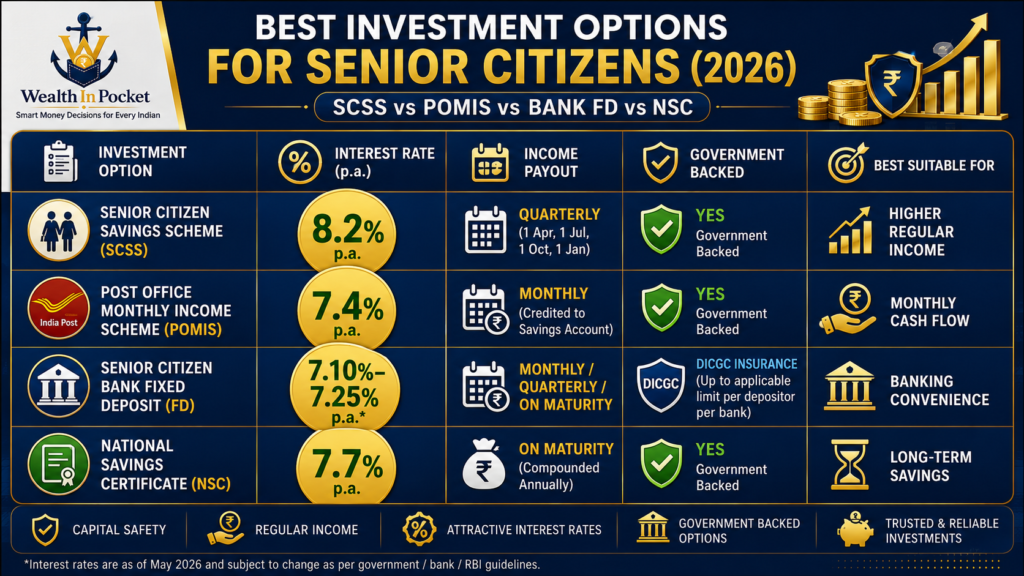
Before comparing these schemes, one important tax update deserves attention.
From 1 April 2026, Form 15G and Form 15H have been replaced by Form 121. Eligible investors may submit Form 121 to their bank or post office, subject to the prescribed conditions, to avoid TDS deduction wherever applicable.
However, No TDS does not mean tax-free income. If the interest earned is taxable under the Income Tax Act, it must still be reported while filing your Income Tax Return.
Government Guarantee vs DICGC Protection
Another important aspect is investment safety. SCSS, POMIS and NSC are Government-backed schemes, whereas Senior Citizen Fixed Deposits are protected under DICGC insurance up to the applicable insurance limit per depositor per bank. This difference becomes particularly important when investing a large retirement corpus.

Bank deposits are protected under the Deposit Insurance and Credit Guarantee Corporation (DICGC).Currently, deposits are insured up to ₹5 lakh per depositor per bank, including principal and accrued interest.
Example
₹4 lakh FD + ₹50,000 Savings Account = Fully Covered
₹8 lakh FD in one bank = Insurance protection limited to ₹5 lakh
How ₹10 Lakh Grows in One Year
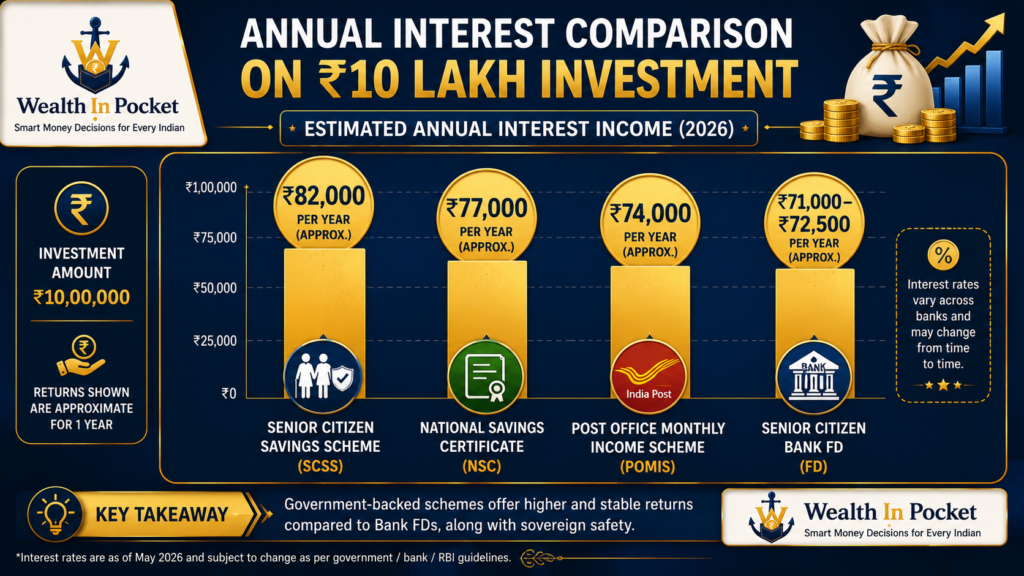
NSC may offer higher returns than Bank Fixed Deposits and POMIS. However, the interest is paid only on maturity, making it more suitable for investors who do not require regular income.
Senior Citizen Savings Scheme (SCSS)
The Senior Citizen Savings Scheme (SCSS) is one of India’s most popular Government-backed retirement schemes. It combines capital safety with regular quarterly income, making it a preferred choice for retirees seeking stable cash flow.
Scheme Highlights
| Feature | Details |
| Interest Rate | 8.2% p.a. (Current Rate) |
| Lock-in Period | 5 Years |
| Extension | Extendable in blocks of 3 Years |
| Minimum Investment | ₹1,000 |
| Maximum Investment | ₹30 Lakh per Individual |
| Interest Payout | Quarterly |
| Interest Credit | 1 Apr • 1 Jul • 1 Oct • 1 Jan |
| Available At | Post Office & Authorised Banks |
| Tax Benefit | Section 80C (as applicable) |
| Interest Taxability | Taxable as per Income Tax Slab |
| TDS | As per applicable rules; eligible investors may submit Form 121 |
Advantages & Limitations
| Advantages ✅ | Limitations ⚠️ |
| Government-backed investment. | Lock-in period of 5 years. |
| One of the highest Government-backed interest rates. | Premature closure may attract penalties. |
| Quarterly interest provides regular income. | Interest earned is taxable. |
| Available through Post Offices and authorised banks. | Interest is paid out quarterly and does not compound. |
| Eligible for Section 80C benefit (subject to applicable provisions). | Maximum investment limit applies. |
| Best Suited For |
| Senior citizens looking for regular quarterly income with Government-backed security. |
WealthInPocket Insight
If your priority is regular quarterly income with a high level of capital safety, SCSS continues to be one of the strongest retirement investment options available. However, if your monthly household expenses require a fixed monthly cash flow, you may also compare it with the Post Office Monthly Income Scheme (POMIS) before making your decision.
Post Office Monthly Income Scheme (POMIS)
If you prefer receiving a fixed income every month instead of every quarter, the Post Office Monthly Income Scheme (POMIS) is another Government-backed option worth considering. It is designed to provide a predictable monthly cash flow, making it suitable for retirees who depend on investment income for their day-to-day expenses.
Scheme Highlights
| Feature | Details |
| Interest Rate | 7.4% p.a. (Current Rate) |
| Lock-in Period | 5 Years |
| Minimum Investment | ₹1,000 |
| Maximum Investment | ₹9 Lakh (Single) • ₹15 Lakh (Joint) |
| Interest Payout | Monthly |
| Interest Credit | Linked Savings Account |
| Available At | India Post |
| Tax Benefit | Not Available under Section 80C |
| Interest Taxability | Taxable as per Income Tax Slab |
| Premature Closure | Allowed after prescribed period with applicable conditions |
Advantages & Limitations
| Advantages ✅ | Limitations ⚠️ |
| Government-backed investment. | Lower return than SCSS. |
| Monthly income for regular expenses. | No Section 80C benefit. |
| Simple and easy to understand. | Interest earned is taxable. |
| Suitable for pensioners needing monthly cash flow. | Maximum investment limit applies. |
| Interest credited directly to linked Savings Account. | Premature closure conditions apply. |
| Best Suited For |
| Senior citizens looking for regular monthly income with Government-backed security. |
WealthInPocket Insight
If your monthly household expenses depend on investment income, POMIS can be a better choice than SCSS because it provides monthly cash flow. Although the interest rate is lower, the convenience of receiving money every month makes it attractive for many retirees.
Senior Citizen Fixed Deposit
Senior Citizen Fixed Deposits continue to be one of the most popular investment options because of their simplicity and easy availability. Almost every bank offers special Fixed Deposit rates for senior citizens, making them a convenient option for those who prefer dealing with their existing bank.
Scheme Highlights
| Feature | Details |
| Interest Rate | Varies by Bank |
| Tenure | Flexible (7 Days to 10 Years) |
| Minimum Investment | Bank Specific |
| Maximum Investment | No Fixed Limit |
| Interest Payout | Monthly / Quarterly / On Maturity |
| Available At | Banks |
| Tax Benefit | Tax Saver FD eligible under Section 80C (5-Year Lock-in) |
| Interest Taxability | Taxable as per Income Tax Slab |
| Safety | Covered under DICGC insurance up to applicable limits |
Advantages & Limitations
| Advantages ✅ | Limitations ⚠️ |
| Easily available at banks. | Not Government-backed. |
| Flexible tenure options. | Interest rates differ across banks. |
| Flexible interest payout options. | Interest is taxable. |
| Simple investment process. | Large deposits require understanding of DICGC limits. |
| Online renewal available in many banks. | Returns may be lower than SCSS. |
| Best Suited For |
| Investors looking for banking convenience and flexible investment tenure. |
WealthInPocket Insight
If you already have a good banking relationship and require flexibility in tenure or payout options, Senior Citizen Fixed Deposits remain a practical choice. However, compare the prevailing FD rates with Government-backed schemes before investing.
National Savings Certificate (NSC)
The National Savings Certificate (NSC) is another Government-backed savings scheme designed primarily for long-term capital preservation rather than regular income. Unlike SCSS and POMIS, it does not provide periodic interest payouts. Instead, the interest is reinvested and paid along with the maturity amount.
Scheme Highlights
| Feature | Details |
| Interest Rate | 7.7% p.a. (Current Rate) |
| Lock-in Period | 5 Years |
| Minimum Investment | ₹1,000 |
| Maximum Investment | No Upper Limit |
| Interest Payout | On Maturity (Compounded Annually) |
| Available At | India Post |
| Tax Benefit | Section 80C (Subject to applicable provisions) |
| Interest Taxability | Taxable as per Income Tax Rules |
Advantages & Limitations
| Advantages ✅ | Limitations ⚠️ |
| Government-backed investment. | No regular income during tenure. |
| Compounding helps grow the investment. | Five-year lock-in. |
| Eligible under Section 80C. | Interest is taxable. |
| No maximum investment limit. | Not suitable for retirees needing monthly cash flow. |
| Suitable for long-term savings. | Premature withdrawal is restricted. |
| Best Suited For |
| Investors focusing on capital preservation and long-term savings rather than regular income. |
WealthInPocket Insight
NSC is a suitable option for investors who do not require immediate income and wish to grow a portion of their savings safely over the long term. It complements income-generating schemes like SCSS and POMIS rather than replacing them.
Which Scheme Should You Choose?
There is no single investment that is perfect for everyone. The right choice depends on your financial goals and income requirements.
| If Your Priority Is… | Consider |
| Highest Government-backed Return | SCSS |
| Monthly Income | POMIS |
| Banking Convenience | Senior Citizen FD |
| Long-Term Capital Growth | NSC |
Some retirees may even choose a combination of these schemes to balance regular income, capital safety and liquidity.
Final Thoughts
Retirement planning is not about finding the investment with the highest advertised return. It is about choosing investments that match your financial needs while protecting the savings you’ve built over a lifetime.
Government-backed schemes such as SCSS, POMIS and NSC continue to be among the safest options available for conservative investors, while Senior Citizen Fixed Deposits offer flexibility and banking convenience.
Before investing, always compare the latest interest rates, understand the taxation rules, check the lock-in period and ensure that the scheme aligns with your income requirements and financial goals.
For investors who already have a sizeable mutual fund portfolio, Systematic Withdrawal Plans (SWPs) may also be explored separately. However, since they are market-linked, they should not be considered a direct replacement for Government-backed retirement income schemes.
WealthInPocket Verdict
A well-planned retirement portfolio doesn’t always depend on a single investment. Combining different schemes based on your financial needs can often provide a better balance between regular income, capital safety and long-term financial stability.
Pehle Samajhiye… Phir Faisla Kijiye.
Disclaimer
This article is intended solely for educational and informational purposes and should not be considered investment or tax advice. Interest rates, taxation rules and scheme guidelines are subject to change. Investors are advised to verify the latest information from the respective Government department, bank or post office before making any investment decision.
Frequently Asked Questions (FAQs)
Which is the best investment option for senior citizens in 2026?
There is no single best option for everyone. SCSS offers one of the highest government-backed returns with quarterly income, POMIS provides monthly income, Senior Citizen FD offers banking convenience, and NSC is suitable for medium-term savings. The right choice depends on your income needs, liquidity and financial goals.
Are Senior Citizen Fixed Deposits safe?
Senior Citizen Fixed Deposits with scheduled banks are generally considered safe. Deposits are insured by DICGC up to the applicable limit per depositor, per bank. Investors should also consider the bank’s reputation and financial strength.
Is NSC better than a Fixed Deposit?
NSC is a government-backed savings certificate with compounded returns, while Fixed Deposits offer flexible tenures and payout options. The better choice depends on whether you prioritize guaranteed government backing or banking convenience.
What is a Systematic Withdrawal Plan (SWP), and is it suitable for senior citizens?
A Systematic Withdrawal Plan (SWP) is a facility offered by mutual funds that allows investors to withdraw a fixed amount at regular intervals, such as monthly or quarterly, from their mutual fund investments. Unlike SCSS, POMIS, or NSC, an SWP is market-linked, so returns and the remaining investment value can fluctuate. It may be suitable for some investors who already have a mutual fund portfolio and understand the associated risks. Since every investor’s financial situation is different, SWPs should be evaluated carefully before use.
Thanks for sharing this valuable information. Choosing the right mix of SCSS, NSC, POMIS, and Bank FDs can help build a secure and stable investment portfolio.
I was looking for long time investment but not able to understand what to do ,which one to choose. Now the things seems clear. Thank you
Insights of your post consists of Good monetary information and Values. BZ Thanks sir